
The simplest, most cliché questions are often the most “controversial.” This is a global internet trend—regardless of the language, people love to rehash these topics because the barrier to entry is low and they are excellent at generating traffic. However, I’ve always felt this kind of hype is most prevalent in Simplified Chinese internet circles. These old topics that resurface periodically as “new controversies” are what we call “menstrual posts” (recurring cycle posts).
Examples include: “Why is Hong Kong so backward in electronic payments?” or “Why hasn’t Markdown gone mainstream?”
The answer is actually quite simple: Markdown isn’t that good to use. Its “usability” is strictly limited to the tech circle—a group of people who deal with code all year round.
Arrogant “Usability” and the Real Barrier
As a writer, I first heard about Markdown’s “superiority” nearly a decade ago. I started learning it, tried it out, and even bought a Markdown-supported writing app on Mac. It cost me a few dozen dollars—not expensive for a Mac app—but after using it for a while, I gave up and crawled back to the embrace of Google Docs.
Markdown sounds simple, but it has a learning cost. Memorizing the syntax is only the first step; you also need a supporting app to render that syntax. There are countless such apps, but quantity doesn’t equal quality. For the average person, this abundance actually creates a “paradox of choice.”
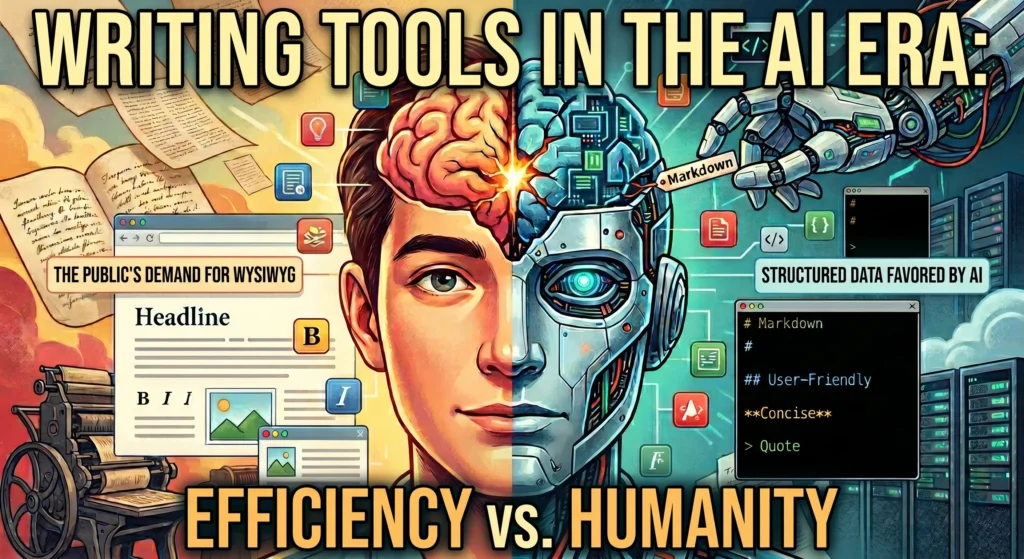
What the public needs most is WYSIWYG (What You See Is What You Get). This has been the primary direction of computer interface evolution for the past few decades. Users just want to click a button for formatting; they don’t care if the backend is complex or if the system is “bloated.” Are Word and Google Docs not good enough? (Word costs money, but Google Docs is free). Why should I learn a whole new method and find new software just for some ethereal sense of “minimalism”?
People who ask “Why hasn’t Markdown gone mainstream?” are either genuinely dense—unable to distinguish between what’s truly user-friendly and what isn’t—or they know exactly how difficult it is for the average person but choose to ignore it. It’s a form of arrogance, a belief that “ordinary people just don’t understand its beauty.” It’s like a classical music snob looking down on pop fans with a misplaced sense of superiority.
Of course, there’s a reason Markdown is being discussed again. It lacks complex formatting, offers high information density, is AI-friendly, and probably saves on tokens. But humans and AI are fundamentally different. Writing and reading Markdown is a built-in capability for AI; it doesn’t need to “learn” it, and unlike humans, it doesn’t require visual aesthetics. For AI, readability means structured data. Those exquisite layouts designed for human eyes are, to an AI, nothing but interference.
When Humans Start “Accommodating” Machines
AI was supposed to do the “grunt work” for us. The greatest progress in the recent AI explosion is that its understanding and processing of natural language have approached human levels. Humans no longer need to learn “machine language” to give commands; even someone who doesn’t know a lick of coding can generate code. Yet, some people are now doing the exact opposite. Seeing that a certain format is “AI-friendly,” they feel that we humans should adapt and adopt the machine’s preferred format.
A similar controversy appeared between TUI (Terminal User Interface) and GUI (Graphical User Interface) after AI coding became popular. Developers might find TUIs more efficient, and that’s fine, but GUIs will always be more accessible to the general public. This is why tools like Claude Code and Codex, despite having TUI versions, still develop GUI versions—they are a necessity for expanding their user base.
Let’s be honest: do you really find those Markdown documents spat out by AI comfortable to read? If so, then your visual system and brain might have already evolved, transcending the “low-level” human needs for perception and aesthetics.
If this type of person becomes the mainstream, they might look at the text layouts from the late 20th to early 21st century and exclaim: “So this is how ancient people used to read!”
What a “bright” future! But I can’t help but wonder: is this truly the direction of human evolution? Humans originally ate just to stay full. Why, then, did we start caring about taste and presentation? After satisfying our hunger, why did we start worrying about nutrition? And once we had nutrition, why did we demand a “balanced diet”?
Writing tools are, at their core, tools. But behind every tool, there is more than just utility. If you reduce it to a mere tool and judge its value solely through the logic of efficiency, you lose your humanity. We risk becoming humans alienated by our own technology. If a Cyborg is a carbon-based lifeform gaining a stronger physical body by integrating tools, then this “tool-first” mindset—which discards humanity for efficiency—is a way of re-engineering the human mind into a machine.
This is perhaps the common ailment of our era: in order to make our tools more efficient, we are making ourselves more like tools.
Chinese version:AI時代的文字工具
