
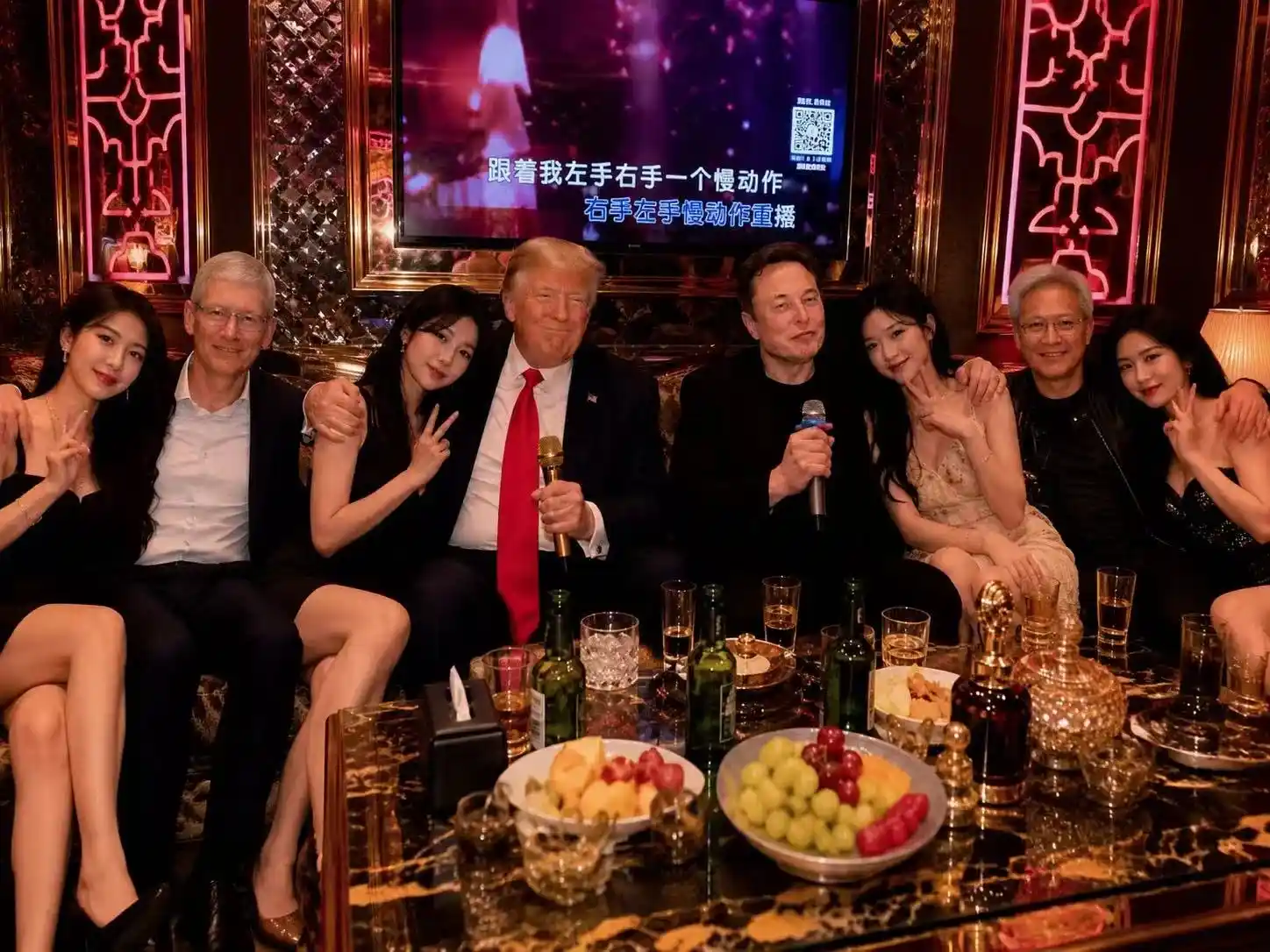
In Donald Trump’s high-powered business delegation to Beijing, Tim Cook looked like yesterday’s news. Already a lame-duck CEO and a frequent, somewhat sterile flier to China, Cook’s lack of raw charisma meant his presence barely registered as a blip on the radar for the Chinese tycoons gathered at the state banquet.
The spotlight belonged exclusively to Jensen Huang and Elon Musk—the two brightest rockstars in the tech pantheon.
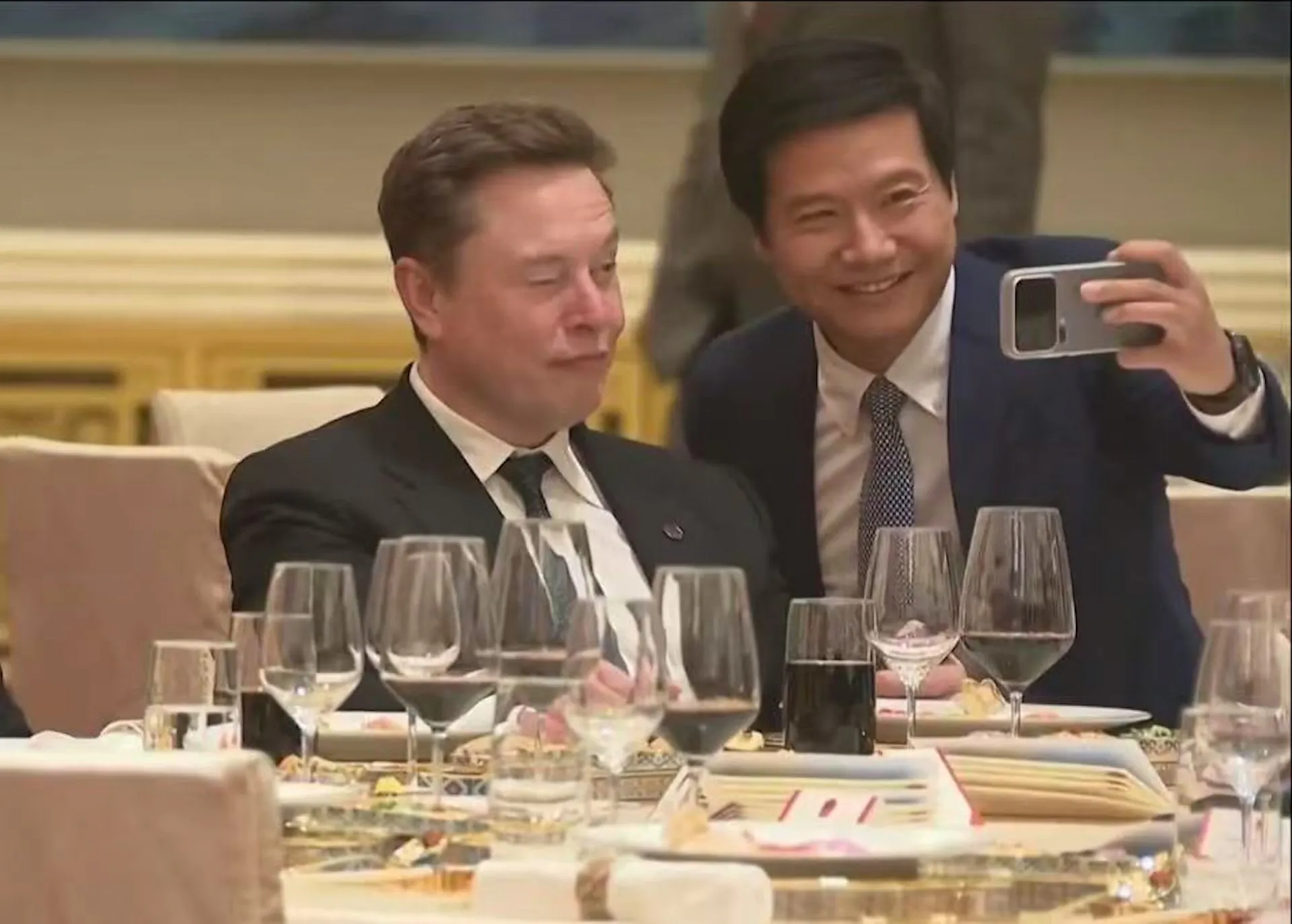
Both are frequent visitors to China and living emblems of “Sino-US cooperation.” But where Huang retains the measured dignity of a traditional tech visionary, Musk operates as a weaponized influencer. Chinese tech bosses, who spend their daily lives playing the part of infallible corporate godfathers, instantly dissolved into giddy fanboys the moment Musk walked in. Even Lei Jun—the billionaire founder of a massive conglomerate—seemed to shrink into a knockoff factory owner on the spot, utterly paralyzed by what anime fans would call Musk’s sheer, overpowering Haki. Critics slammed Lei Jun for tapping Musk on the shoulder to beg for a photo, calling it a breach of etiquette. What I saw was something else: the raw, trembling anxiety of a starstruck admirer.
Word has it that Musk, still scarred by a youthful rejection from his own idol Steve Jobs, rarely turns down a fan. He obliges with a rotating gallery of goofy, expressive grimaces, guaranteed to feed the social media meat grinder. Personally, I am no fan of Musk, and I find his politics abhorrent. Yet, denying his gravitational charisma is impossible.
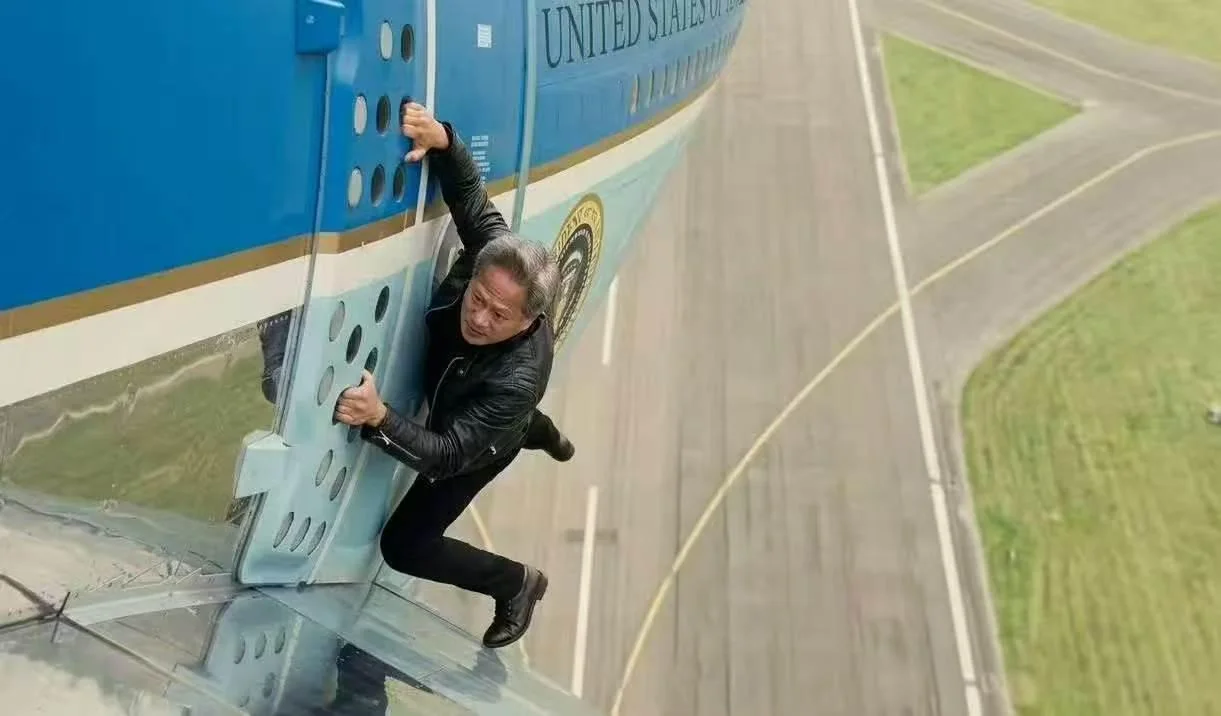
Jensen Huang, on the other hand, doesn’t need to perform. Boarding a flight to China midway through Alaska while rocking his signature leather jacket was enough to stop the global internet in its tracks and ignite a cascade of memes. A founder’s aura doesn’t require megaphone diplomacy; the product usually does the talking. Steve Jobs was the gold standard of this philosophy. He lacked Musk’s loud theatricality. In fact, if Jobs were running Apple today, I highly doubt he would have swallowed his pride to squeeze onto Trump’s crowded Air Force One. Huang is cut from that same Jobsian cloth, even if one favored leather jackets and the other preferred black turtlenecks. When Huang initially claimed he wasn’t invited to the Beijing trip, I suspected he simply didn’t want to go. In the end, he compromised.
This picture-perfect display of Sino-US corporate harmony is exactly the optics Beijing wants to broadcast to the world. But I wonder if they realize it exposes a harsher truth: the staggering chasm between American and Chinese enterprises.
You don’t even need to look at market caps. The sheer power dynamics of these interactions tell the whole story. American tech moguls are idols to their Chinese counterparts not just because they have bigger personalities, but because they possess the raw muscle to back it up. If these men were all style and no substance, Chinese executives wouldn’t be groveling for a snapshot. For a Chinese tech boss, snapping a photo with Musk isn’t just an act of submissive worship; it’s a calculated play for viral traffic.
Flip the script. Is there a single Chinese entrepreneur today who commands that level of reverence from American peers? To the average Chinese consumer, Lei Jun is a towering celebrity to be worshipped from afar. But strip away the domestic context and drop him onto the global stage, and he reverts to looking like a provincial tech hustler. The video he posted on X (formerly Twitter) showcasing his test drive of Xiaomi’s new EV felt like a cheap, second-rate imitation. Of course, anyone with an internet memory knows this isn’t new. To many, he will always be the man behind that painfully awkward English speech—a deafening, unforgettable “Are you OK?” that still echoes across the web.
Now, if we consider the Chinese Communist Party a corporation and Xi Jinping its CEO, then technically, the answer to that question is yes—there is a Chinese figure with a fanatical American corporate following. Except his biggest admirer didn’t make the flight to Beijing this time. This particular US tech mogul has spent years aggressively courting the Chinese government, even conspicuously placing Xi’s published works on his office desk. Yet, that desperate flattery failed to buy him a ticket into the Chinese market. Just recently, Beijing ruthlessly blocked his acquisition of a Chinese AI startup. Mark’s virtual playground isn’t like Elon’s physical machines; China doesn’t just find the former redundant—it fears its uncontrollable influence. Elon, conversely, brings the tangible manufacturing ecosystems Beijing actually needs.
Setting Xi aside, Jack Ma was the closest thing China ever had to a charismatic tech icon (a reality Lei Jun likely disputes, given how hard he tries to play the part). But Ma’s current forced retirement is the direct result of that very charisma becoming too loud for comfort. The political and economic soil of China simply cannot tolerate, let alone cultivate, such figures. Ma might not have been an idol to American CEOs, but he was at least a peer they took seriously. Eloquent and sharp, he could hold his own with international heavyweights and was a darling of the Western press.
At the end of the day, the fundamental missions driving these two groups—even when stripped down to pure marketing spin—exist on entirely different planes. China’s top-tier entrepreneurs are content with perfecting the art of the affordable commodity (a direction Cook ironically seems to be dragging Apple toward). Consequently, they carry very little psychological or legal baggage when it comes to copying and imitating. Even Jack Ma, at the peak of his hubris, merely aspired to ship these cheap goods globally under the noble banner of “helping small businesses.” American founders, for all their flaws, build toward grander, almost mythic horizons. Musk wants to colonize Mars—and his staggering investments in SpaceX prove he isn’t just blowing smoke.
The traditional Chinese ethos preaches “high-profile execution, low-profile living.” Yet, looking at the industry’s deceptive marketing stunts and hearing the endless, shrill chants of being “generations ahead,” I can’t help but think Chinese tech companies should try executing quietly for once. True stature isn’t built on loud bluster and consumer deception.
Lately, the internet has been flooded with satirical memes imagining American tech billionaires letting loose in a gaudy, traditional Chinese karaoke lounge. The brilliance of these memes lies in how brutally they caricature the distinct business cultures and leadership styles of both nations. Lei Jun might not frequent those specific neon-lit dens of vice, but within the cultural imagination, he belongs to that tacky corporate ecosystem. Musk should probably pull Lei Jun aside and give it to him straight: “Take a hit of this joint, drop the counterfeit factory vibe, and build something that actually touches the soul. You know, like Steve and me.”
Chinese version:中美企業家的差距——抑或中美企業的差距